
Tewksbury Previous Residents Sources
Previous residents of a Tewksbury address are best traced by separating title records from occupancy clues. A recorded deed follows a transfer of land. A street list can place adult residents on a street in a stated year. Maps, plans, annual reports, newspapers, and institutional material can add a date or local context. None of those sources automatically names every person who lived at an address. The record trail changes by era, and the older Registry search methods differ sharply from the newer name and property searches.
| Source | Years It Covers | Where Held | What It Shows |
|---|---|---|---|
| Middlesex North Recorded Land name index | 1976 to present | MassLandRecords Middlesex North | Parties, document data, town, book or page, and document type |
| Registry Property Search | 1976 to present | Middlesex North Registry | Address-keyed deed leads, strongest from the late 1990s |
| Registry Book Search | 1950 to present; Book 1132 onward | Middlesex North Registry | Scanned deed-book pages and multipage documents |
| Unindexed property and pre-1976 indexes | 1855 to 1949, plus pre-1976 index books | Middlesex North Registry | Earlier transfers found by book or grantor/grantee pages |
| Resident-by-street lists | 1965 to present | Tewksbury Public Library Local History Room | Incomplete list of residents ages 17 and over |
| Almshouse intake archive | Primarily 1860 to 1884 online | UMass Lowell and Public Health Museum project | Institutional admission details, not an ordinary residence record |
Start with the current parcel and a recent recorded transfer, then move to the right Registry era. When the goal shifts from owner history to who lived there before, use the library’s dated lists and contextual sources. A past-resident result should preserve the document type and date so the next researcher can tell an ownership link from a historical address clue.
Note: A vacant address result can reflect a changed search method, not the absence of earlier records.
Tewksbury Previous Residents Registry Era
Tewksbury is in the Middlesex North Registry district. A Middlesex South search can therefore make a deed trail appear to be missing. The Registry’s scanned land books reach from 1629 forward, but the online index is not one continuous system. Recorded Land name searching is strongest from 1976 onward. Property Search also begins in 1976, while street-address indexing is routinely strongest only from the late 1990s. Search a street number and name without assuming the same Street, Road, or Avenue abbreviation used in a later record.
For a broad first pass, the Registry recommends omitting a middle initial, then adding it to narrow the results. Advanced filtering can use document type, town, and date range. Deeds recorded from 1976 through 1986 may carry document type “none,” so that value belongs in a careful search. If an address does not return a result, pivot to the current owner’s name, then to grantor, grantee, and book or page. This local index breakpoint is why previous-residents research cannot safely begin and end with a single address query.
Tracing Tewksbury Previous Residents Deeds
The Middlesex North Registry of Deeds is the controlling title-record office for Tewksbury. Begin with the current owner and parcel details shown in the town’s Vision assessor search, then find the owner’s acquisition deed. A modern deed usually contains a title-reference paragraph that points to the prior deed. Read the image itself. It can carry the book and page, plan reference, document type, parties, recording date, and the legal description that supports the next step backward.
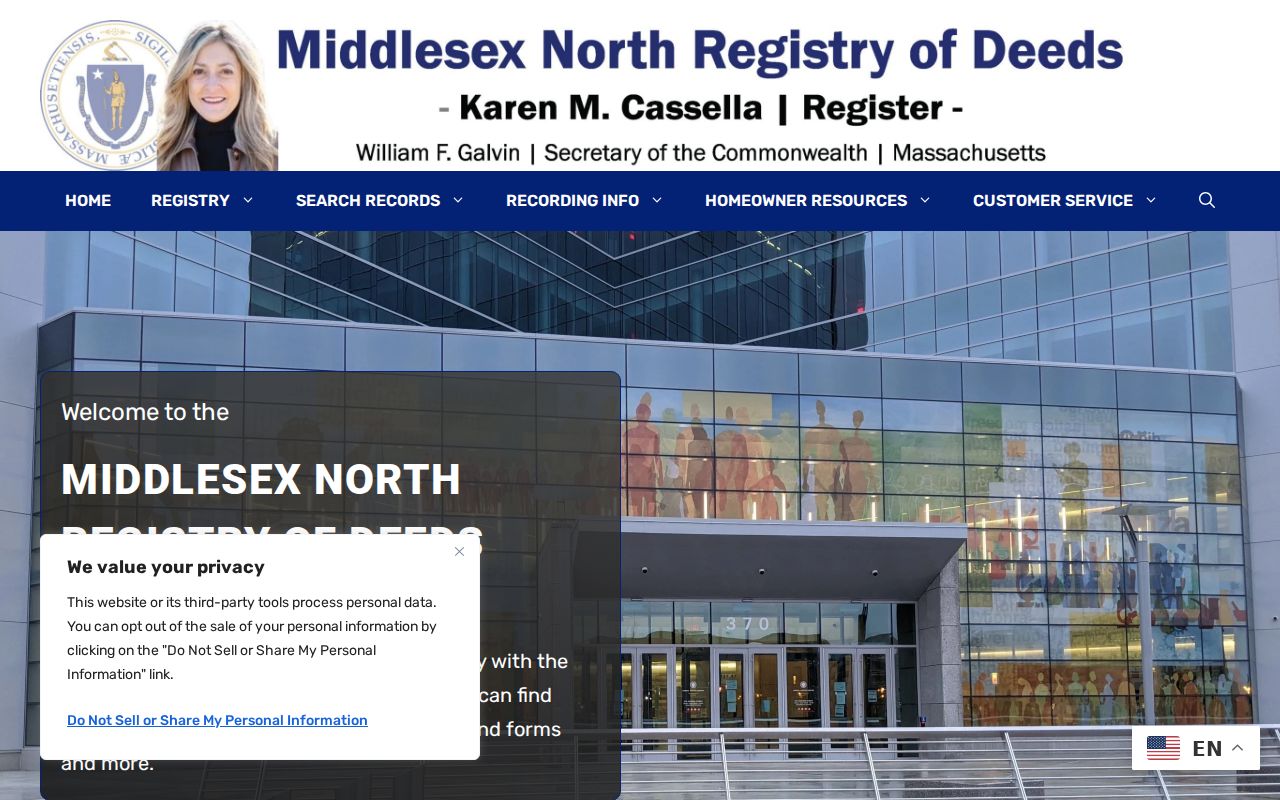
The Registry gateway shown in the screenshot leads to free search and download access, while the office can provide counter assistance, phone or email help, and certified copies when a formal record is needed.
- Use the assessor result to capture the current owner, parcel identifiers, and exact property wording without treating the assessment record as proof of title.
- Find the owner’s acquisition deed in Middlesex North, using a party name, document data, town, or property search according to the era.
- Read the title-reference paragraph and search the seller as a grantee to locate that seller’s earlier acquisition.
- Repeat the sequence backward, transcribing the recording date, parties, book or page, plan reference, and document type for each link.
- Move into Book Search, unindexed property images, or scanned grantor/grantee pages when the chain reaches an older index system.
- Grantor and grantee
- The grantor is the seller or transferring party. The grantee is the buyer or receiving party. In an older chain, the seller’s name can lead to the prior acquisition.
- Chain of title
- A sequence of recorded transfers connecting one title holder to an earlier one. It is not a statement that every occupant was an owner.
- Legal description
- The parcel wording or plan-based description in a deed. It can outlast a street-number change and helps connect older documents to the same land.
- Instrument number
- A Registry document identifier used for Recorded Land searching. Since 2002, it is assigned together with book and page.
Tewksbury Previous Residents Old Books
Book Search covers 1950 to the present and Book 1132 onward. Books 1132 through 1590 return single-page images. Book 1591 and later return a multipage document, and a book search without a page can return all pages. Document Search covers 1976 to the present by instrument number. A recorded-date search works best with the same date in both date fields and then a manual review of the results because the portal does not export a result set.
For 1855 through 1949, Unindexed Property Search requires book and page plus image inspection because those records are not computer-indexed. Pre-1855 books use a separate scanned sequence. Pre-1976 Grantor and Grantee Indexes are scanned electronic books arranged by year range. The page may display the first name on a scanned page, so inspect nearby names with the arrow controls and read the entries before and after a likely match. This is slower than a modern address search, but it matches the historical record system.
Note: Keep book-page citations exactly as displayed, including plan suffix letters and any court case number.
Tewksbury Previous Residents Address Changes
Address continuity is the hard part of a long house trail. The sources inspected did not locate a single official Tewksbury renumbering or address-change index. Roads, lot lines, parcel identifiers, and street numbering can change through subdivision and municipal addressing. A mismatch should remain a possible match until a deed plan, municipal record, or another bridge source actually connects the old wording to the current parcel.
Use the Tewksbury MapsOnline GIS to compare parcel identifiers, addresses, street names, and historical aerial layers. The viewer includes aerial basemaps from 1995 through 2023, as well as parcel, zoning, wetlands, flood, and other layers. Pair a map view with a deed’s legal description or plan reference. The GIS is an informational research aid, not a survey, legal description, or guarantee of accuracy.
Tewksbury Previous Residents Local Lists
Ownership is only one part of a past-residents search. Tewksbury’s “List of Residents by Streets, Ages 17 Years and Over” begins in 1965, continues to the present, and is incomplete. Telephone directories begin in 1998, and the Cole Directory for Lowell and vicinity adds a regional source for 2005 through 2014. These dated materials can place adults or subscribers near an address, but they do not convert a title owner into an occupant or prove a full household roster.
The annual town census is a separate municipal administrative record. Tewksbury’s 2024 notice asked residents to return the form promptly and directed new residents or nonrecipients to the Town Clerk. The research does not describe a public, searchable household-by-address census series. Individual census information is subject to public-record exemptions and local retention rules. Treat the annual census as a date and custodian clue, not as a public replacement for a street list.
- Choose the street-list year closest to the deed or address period being tested.
- Record the name, street form, age threshold, and incomplete-series warning exactly as the local list presents them.
- Check nearby street-list and telephone-directory years for a move, a spelling change, or a gap in the holdings.
- Use the Town Clerk for a narrow question about releasable census administration or records policy rather than asking for individual census responses.
- Test the trail against dated newspapers, annual reports, maps, and recorded documents before describing a past connection.
The collection details and access rules are available through the Tewksbury City Directory collections. The Local History Room, reference desk, online archive, and staff-assisted requests provide different channels when a volume is not online.
Tewksbury Previous Residents Map Clues
Library maps, annual reports, newspapers, and Sanborn microfilm can add context to an address after the Registry chain is documented. The Local History Room holds historical and contemporary maps, annual reports from 1878 to the present, and Lowell-area Sanborn Fire Insurance Maps on microfilm. The research did not locate a confirmed standalone digitized Tewksbury Sanborn viewer or exact sheet years. Ask the reference desk which sheets include the address, record the map date, and compare the building footprint, street, and lot with a deed plan and GIS parcel.
The Massachusetts genealogy research guidance is useful when a local trail turns into a wider vital-record question. State Archives records cover 1841 through 1935, RVRS research coverage begins in 1936, and Tewksbury’s local Tan Book reaches 1849. Access restrictions are record-specific, so a date alone does not settle eligibility or availability.
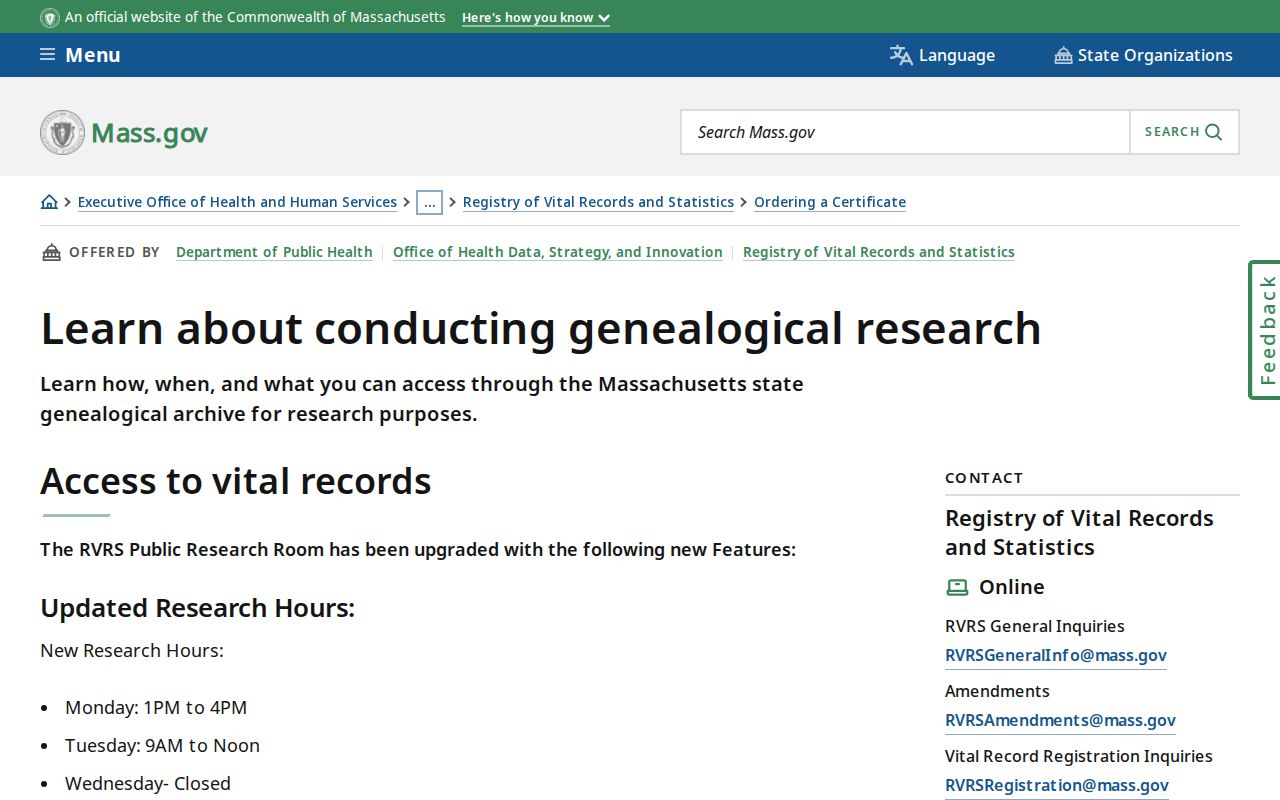
The state genealogy screen reinforces the need to route an event to the correct custodian and date range before ordering or interpreting a record.
Tewksbury Previous Residents Historical Trails
The Tewksbury Almshouse Intake Records collection can resolve a narrow historical identity, especially where a person has an alias, birthplace detail, or maternal cross-reference. It includes about 24,000 records from original ledgers and about 18,000 scanned microfilm records. Public digital coverage is primarily 1860 through 1884, with a privacy-driven endpoint into the 1890s. It is an institutional intake collection, not evidence that someone maintained an ordinary address in town.
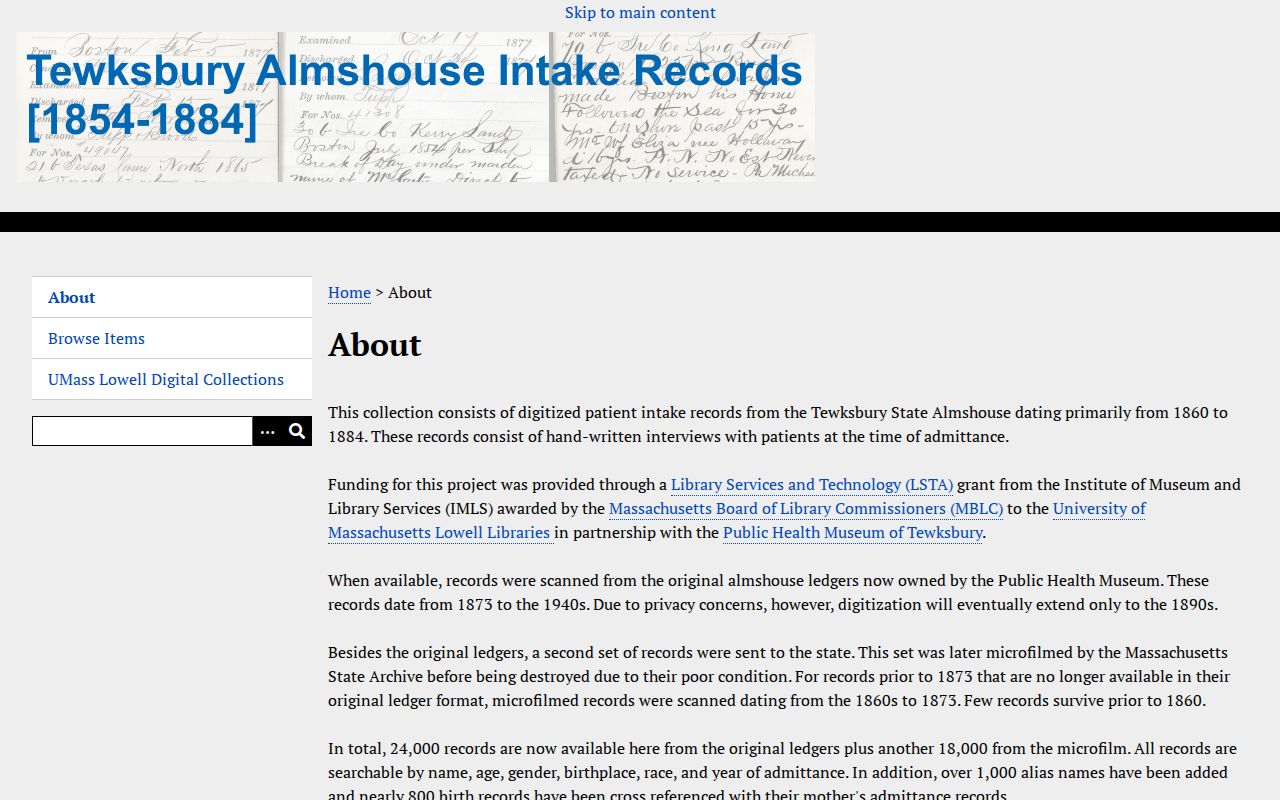
The collection image is a reminder to retain the original institutional setting and date when using a historical name match.
For a place-based event trail, the 1903 Riverside Park Explosion collection includes an investigation report, foldout map, photographs, newspaper coverage, and 170 settled claims. The library reports 25 deaths and 100 injuries. A researcher can compare the affected area with deeds, maps, and local directories, but a claimant, witness, or victim should remain connected to the specific historical source rather than being assumed to identify a present-day family.
Tewksbury Previous Residents Limits
A past-resident trail should support documented address history, family research, estate and heir questions, or local history. It should not be used to target, track, or disturb a living person. Massachusetts public records can contain redactions, protected addresses, sensitive personal details, or documents that are public only in part. A visible owner name may also belong to a trust, estate, business, attorney, or other fiduciary rather than an occupant.
Lawful use. Use Tewksbury previous-residents research for personal, historical, or civic questions, and do not use a record to harass or harm anyone. Massachusetts law treats criminal harassment as a serious offense.
For an address-sensitive safety issue, ask the record custodian about redaction or suppression rather than trying to infer a protected location from a second source. A deed, assessment display, map layer, or old directory does not remove an active confidentiality boundary. For a title, boundary, lien, or sale dispute, rely on the Registry record and a qualified title professional or attorney.