
Tewksbury City Directory Collections
Tewksbury does not rely on one uniform, continuously published city-directory run. The strongest local shelf combines a resident-by-street series, telephone books, a regional directory, newspapers, yearbooks, annual reports, and historical reference material. The Tewksbury Public Library Local History collection identifies which materials are available locally. Read each item for what it was made to record. A street list is useful for placing adult residents on a street; a telephone directory reflects subscribers; and a yearbook records a school community rather than a complete town population.
| Collection | Years | Where Held | Access |
|---|---|---|---|
| List of Residents by Streets, Ages 17 Years and Over | 1965 to present | Tewksbury Public Library Local History Room | Incomplete series; request at the reference desk |
| Telephone directories | 1998 to present | Tewksbury Public Library Local History Room | Local historical collection |
| Cole Directory for Lowell and vicinity | 2005 to 2014 | Tewksbury Public Library | Regional context for a name or address |
| Advocate, Town Crier, and Scroll selections | Varies by title | Advantage Preservation archive | Free advanced online search |
| Tewksbury annual reports | 1878 to present | Local History Room | Municipal names, offices, and town context |
Use the table as an access map, not as proof that every year or every person is present. The library calls the street-list series incomplete, and its age threshold excludes children and younger teens. The material also spans different purposes. That distinction keeps a Tewksbury city directory search from turning a partial record into a claim about an entire household.
Note: Record the title, issue year, page, and access date before comparing a directory result with another source.
Tewksbury City Directory Street Lists
The resident-by-street lists are the closest local equivalent to a reverse directory. They begin in 1965 and list residents aged 17 and over, but the library specifically describes the run as incomplete. Search the same street across several available years rather than relying on a single volume. A newly appearing name may mark a move, a return of a form, or a difference in compilation. A missing name may reflect the age cutoff, an omission, a missing issue, or a changed form of the name.
Telephone books begin later, in 1998, and add a different kind of evidence. They are subscriber records, not a complete list of everyone at an address. The Cole Directory covers Lowell and vicinity from 2005 through 2014, so it can supply regional context when a Tewksbury search touches nearby communities. Keep the source labels separate in notes. A person on a street list and a person in a phone book are not automatically the same record type or the same level of confirmation.
Reading a Tewksbury City Directory
A Tewksbury city directory result should be read as a source-specific entry, not as a standardized profile. The research materials document several kinds of directory evidence but do not establish one shared entry format across all of them. Capture the wording as printed, then note what collection produced it. That simple habit is important when a person used an initial, a nickname, a married surname, or a different street form in another year.
| Name form | Preserve the exact spelling, initials, and sequence shown in the street list, telephone directory, yearbook, or newspaper result. |
|---|---|
| Street or address | For the resident-by-street series, note the street and the year, then compare the same address across nearby volumes. |
| Collection type | Identify whether the result came from a street list, telephone directory, regional directory, yearbook, newspaper, or annual report. |
| Date context | Record the volume year or the archive date range, because the same address can change over time. |
| Limits | Mark incomplete holdings, the street-list age threshold, and any missing yearbook years before drawing a conclusion. |
- Street-list directory
- A locally held list arranged to associate residents with streets. Tewksbury’s documented series begins in 1965 and is limited to ages 17 and over.
- Householder
- The person named for a household in a historical source. A source may use that name without identifying every person connected to the address.
- Abbreviation key
- A page in a historical volume that explains its shortened forms. Photograph or transcribe it before interpreting a shorthand entry.
Tewksbury City Directory Digital Search
The Tewksbury Advantage Preservation archive is a second route when the shelf record is thin. Its advanced search supports multiple term inputs, connector logic, people, places and events, geography, title, and a three-part date range. Search a surname with a street, an institution, or a distinctive local event. Then narrow by title or date instead of treating a broad name hit as a confirmed match.
Digitized yearbooks can help identify a former student, but the Local History collection lists gaps before 1947 and in several later years. A yearbook may provide a class, activity, sibling, or street clue. It does not establish a current connection to an address. For a dated person-and-place question, pair the yearbook hit with a street list, newspaper item, annual report, recorded document, or another record from the same period.
Note: A search result is most useful when its title, date, page, and matching terms are saved together.
Tewksbury Directory Room Access
The Local History Room is open during regular library hours, and staff offer basic help to drop-in researchers. The reference desk can also take a question through Reference-Go, whose form requests contact details, a resource category, and a description of the question. This is the practical fallback when an online search does not reveal the needed volume or when the date range is uncertain.
On site, bring a library card or government ID and sign in and out for Local History Room use. The 2025 policy limits copying based on copyright, condition, and other considerations. It also limits a researcher to two archival boxes or three volumes at a time, requires original folder order to remain intact, and keeps materials in the room for staff reshelving. These rules matter when working with directories, maps, photographs, annual reports, or fragile archival material.
Tracing Tewksbury City Directory Households
For family history, follow the first clear Tewksbury city directory appearance forward and backward through the available years. Do not assume that one entry settles who lived in a home. The library’s street list, telephone books, newspapers, yearbooks, annual reports, maps, and local genealogies each answer a narrower question. A directory series is best used as a dated thread that points toward the next source.
- Start with the exact name form, address, and year from the strongest directory result.
- Check earlier and later street-list volumes for the same street, noting gaps and the ages-17-and-over limit.
- Compare telephone-directory or Cole Directory results only as subscriber or regional evidence, not as a full household roster.
- Search the digitized newspapers and yearbooks with the name plus street, school, organization, or date range.
- Use annual reports, local vital books, maps, and staff-assisted historical sources to test changes in the trail.
Where a directory finding needs current verification, use a separate Tewksbury resident lookup rather than extending an old listing into the present. Historical records have their own dates and limits. Retaining that boundary makes the household trail clearer and more respectful.
Tewksbury Almshouse Name Records
The digitized Tewksbury Almshouse Intake Records are a distinctive historical name source, but they are not a city directory or a general residence list. The collection contains about 24,000 records from original ledgers and about 18,000 scanned microfilm records. Its public online material is primarily from 1860 through 1884, with a privacy-driven endpoint into the 1890s. Search fields include name, age, gender, birthplace, race, year of admittance, aliases, and maternal cross-references.
These records can help resolve a historic identity when a name changes across local sources. They must be read with their institutional context intact. An intake record may concern poverty, illness, guardianship, or temporary custody, and it should never be treated as proof of an ordinary residence. The collection’s own description is the right starting point for its coverage and limits.
Tewksbury Historical Society Evidence
The Tewksbury Historical Society is an established repository and referral point for town artifacts and photographs. Ask whether an item is cataloged, whether a name index exists, whether an appointment is needed, and whether reproduction is allowed. An artifact label or oral-history item can add local context to a directory trail, but it is historical evidence with provenance, not a current address source.
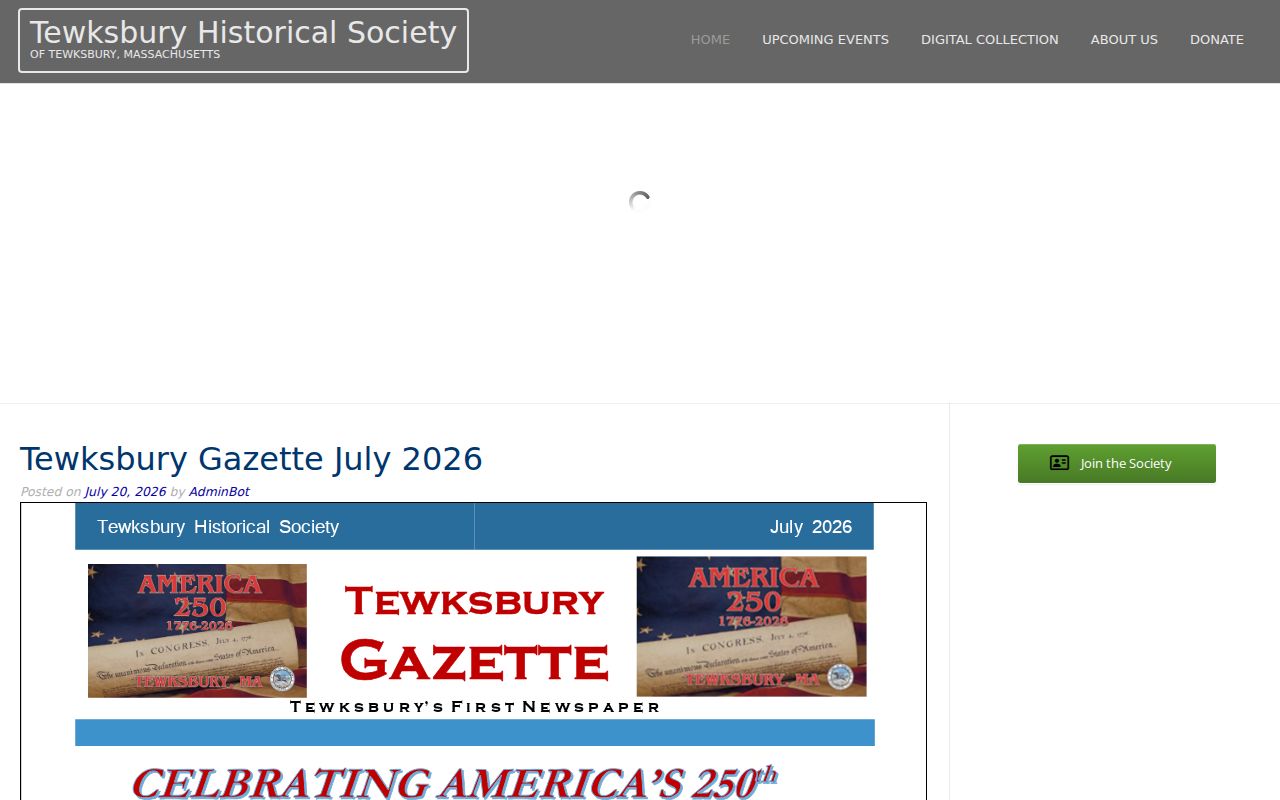
The society screenshot points to a collection gateway, so a researcher should still confirm the exact object, date, access condition, and any reproduction rule with the repository.
Tewksbury Directory Gaps in Reports
Annual reports extend from 1878 to the present in the Local History Room and can bridge a gap that a directory cannot fill. They preserve municipal administration, offices, roads, institutions, and population context. The State Library also lists multiple Tewksbury report holdings, including nineteenth-century ranges. Use an annual report to place a name in a civic or local setting, then keep that narrow role separate from a claim of household residence.
The town’s record history is layered. Tewksbury was settled in 1637 and incorporated in 1734, while later municipal records, regional Lowell material, land books, and institutional archives follow different systems. A 2009 preservation effort included scanning, restoration, fireproof storage, and a preservation fund for historic records. That work helps explain why one historical item may appear in a scan, another in an archive box, and another only through staff assistance.
| 1637 | Local history identifies the first settlement of Tewksbury. |
|---|---|
| 1734 | Tewksbury was incorporated from Billerica, placing later town material in a distinct municipal record trail. |
| 1878 to present | The Local History Room’s annual-report holdings provide a long municipal context series. |
| 2009 | A town preservation effort documented scanning, restoration, fireproof storage, and a preservation fund for historic records. |
Note: When a directory gap remains, document the missing year instead of filling it with an unsupported household match.